
Category: Uncategorized

  • National Registry Board Meeting – June 2023, Public Notice and Call For Public Comment

    2023-06-08

    The following information is archived for transparency and historical purposes. 

    During the June 2023 Board Meeting, the National Registry Board of Directors approved four additional resolutions for public comment. 

    Transparency, collaboration and stakeholder input are essential to the National Registry. As such, the National Registry now provides a 60-day stakeholder comment period to comment on the resolutions.

    The National Registry Board of Directors provided updates on Prehospital Guidelines (EBGs) for initial and ongoing competency (23-Resolution-01); National Continued Competency Program (NCCP) (23-Resolution-02); AEMT Student Minimum Competency (23-Resolution-03); and BLS Practice Analysis (23-Resolution-03); Basic Life Support (BLS) Practice Analysis for EMRs and EMTs (23-Resolution-04). Read the summaries for each policy below. 

    Learn more about the National Registry’s Key Initiatives, which also were introduced during the June Board Meeting. 

    The comment period for Resolution 01, Resolution 02, Resolution 03 and Resolution 04 has closed.

    23-Resolution-01: Prehospital Guidelines Consortium (PGC) Evidence-Based Guidelines (EBGs) for initial and ongoing competency

    23-Resolution-01 permits the National Registry of EMTs use of the Prehospital Guideline Consortium (PGC) evidence-based guidelines (EBGs) and Professional Reading List as a resource for cognitive examinations and National Continued Competency Program (NCCP) recertification model. The evidence-based guideline articles and/or summaries serve as a resource for EMS clinicians and educators to incorporate evidence-based practices into education and daily practice.  

    View Resolution
    Comment period has closed. 

    23-Resolution-02: National Continued Competency Program (NCCP) 

    23-Resolution-02 directs National Registry to update the framework for the National Continued Competency Program (NCCP), a model which encourages lifelong learning through continuing education units (CEUs) for National Registry certificants. The model is also used for candidates seeking National Registry who are state licensed or reentry. Updating the NCCP ensures National Registry certificants maintain the knowledge and skills needed for current practice.  

    View Resolution
    Comment period has closed. 

    23-Resolution-03: Advanced Emergency Medical Technician (AEMT) level Student Minimum Competency (SMC)

    23-Resolution-03 is the introduction of the Student Minimum Competency (SMC) matrix for the Advanced Emergency Medical Technician (AEMT) certification level. This matrix guides State EMS Offices and AEMT programs in establishing state-approved standards to assess and verify a candidate’s competency as a prerequisite for National Registry AEMT certification.    

    View Resolution
    Comment period has closed. 

    23-Resolution-04: Basic Life Support (BLS) Practice Analysis for EMRs and EMTs

    23-Resolution-04 approves the 2022 Basic Life Support (BLS) Practice Analysis and examination specifications for EMRs and EMTs. Practice analyses are routinely conducted to define the job roles, knowledge and skills required for BLS-level practice. The results of the analysis help shape National Registry examinations and the development of future examination content such as test items and questions. 

    View Resolution
    Comment period has closed. 

    As a reminder, the Board of Directors previously approved two resolutions during its April 2023 Board Committee Meetings. The comment period for those resolutions closed in June. 

    The following information is archived for transparency and historical purposes. 

    23-Resolution-05: Policies and procedures related to the ALS Redesign Project

    23-Resolution-05 permits the National Registry of EMTs to update policies and procedures related to the ALS Redesign Project to maintain best practices in certification and maintain compliance with NCCA accreditation standards and Standards for Educational and Psychological Testing.   

    The redesigned ALS examination will replace the existing psychomotor and cognitive examination with one comprehensive computer-based examination. The format, method, and delivery of the examination measures a candidate’s knowledge, skills, and abilities for EMS prehospital care.  

    View Resolution
    Comment period closed on June 26, 2023.

    23-Resolution-06: Implementation date of the redesigned ALS examination

    23-Resolution-06 permits the National Registry of EMTs to proceed with the implementation of the redesigned Advanced Life Support (ALS) examination for AEMT and Paramedic certification levels, starting on July 1, 2024. Additionally, it mandates the sunset of the Psychomotor examination by July 1, 2025.  

    As a reminder, the EMR and EMT skills examinations are administered by each state EMS office.

    View Resolution
    Comment period closed on June 26, 2023.

    Summaries updated June 8, 2023 at 5:00 p.m. EDT. 
  • November 2021 Board of Directors Meeting Summary

    2021-11-16

    COLUMBUS, OH – November 4 and 5, 2021 Meeting Summary of Motions, Resolutions, and Actions 

    • 21-MOTION-23. 2022 Budget and Operating Plan. The Board approved the 2022 Budget and Operating Plan for the National Registry. The document provides an overview of the 2022 budget and operational assumptions that support the execution of the 2022-2023 Board approved strategic plan while also carrying out and improving National Registry operations in executing its mission. Areas of focus for the strategic goals for next year include:
      • Technological security/operational agility. There will continue to be an investment in and development of technology capabilities for business operations, risk reduction, examination infrastructure, and for innovation.
      • Certification/Competency. This goal further advances the organization in its role as the Nation’s EMS certification organization, responsible for assuring competency by providing evidence based, fair, and readily defensible standards and testing for certification, privilege to practice, and specialized practice/operational areas for EMS professionals and candidates.
      • Value & Branding. This goal yields a marketing plan and strategy for the Board that will be derived from a brand development plan.
    • 21-RESOLUTION-22. Updated Terms of Certification. This resolution allows for the current Terms of Certification Policy to be updated. The Terms of Certification Policy specifies essential requirements for National Registry certification and interface with licensure processes that authorize practice of EMS professionals. The specific updates to the policy include simplification of language, clarification of eligibility criteria for certification, differentiation between administrative licensure issues from issues necessary to protect the public, and more. The policy, once updated, will be distributed for public comment.
    • ALS Examination Redesign Update. The National Registry continues to progress with the ALS Redesign initiative. The redesign is an initiative directed by the Board of Directors in 2019 to improve and refine the examinations used for certification. Given the advancement of technologies, improvements in the testing and certification field, as well as feedback from the national EMS community, the Board opted to engage in this initiative. The redesign will focus on AEMT and paramedic examinations. A performance examination will be initiated that assesses clinical judgment in a more comprehensive and reliable method compared to the current methods in the psychomotor (skills) examination. Additionally, a student minimum competencies document will replace the current portfolio requirement and the psychomotor examination requirement will retire once the new performance examination is fully in place by late 2023. Up to date details of and progress with the ALS Redesign can be found here.
    • Continued Competency Agenda Update. The Steering Committee for the Continued Competency Agenda continues to meet with the goal of developing a national Agenda for EMS continued competency and continuing education. However, based on feedback from our EMS partners about too much change happening at once given the simultaneous ALS Exam Redesign, several elements of the Continued Competency Agenda have been placed on pause. To date, a Delphi project was completed to identify consensus themes among EMS employers, managers, educators, medical directors and training officers related to challenges and opportunities faced with continued competency. A manuscript on the findings is in progress and will be presented at the upcoming NASEMSP meeting in January. There has also been progress with the National Clinical Content Task Force with the Prehospital Guidelines Consortium (PGC). The PGC will provide compiled evidence-based guidelines (EBGs) as a basis for further validity with examinations as well as a basis for continued competency. The EBGs have the potential to form the basis for revisions to the NCCP in late 2022. In addition to these accomplishments, the Steering Committee finalized its initial definition for continued competency, as well as drafted a macro-outline for the proposed Agenda on continued competency and continuing education.
    • Elections of Board Officers for 2022-2023. The Board of Directors elected its Chair-elect, Treasurer, and Executive Committee At-Large officers for the 2022-2023 term. The Executive Committee starting on January 1, 2022 will be:
      • Chair: Dr. Kevin Mackey
      • Chair-elect: Dr. Mike McEvoy
      • Treasurer: Dr. Thomas Platt
      • Executive Committee Member At-Large: Dr. Scott Gilmore
      • Past Chair: Dr. Heather Davis
    • Elections of Board Directors. The Board of Directors elected the following directors from the following nominating organizations/positions:
      • AAA: Mr. Adam Heinz 
      • NASEMSO: Mr. Steve McCoy
      • NAEMSP: Dr. Maia Dorsett
      • Educator At-Large: Dr. Kim McKenna (second term)
    • IDEA Task Force. The IDEA Task Force, established to work at the structural and policy level with other key EMS stakeholder organizations, has established monthly Professional Learning Communities where members of the EMS community can learn about a successful program improving inclusion, diversity, equity or access in their area, collaborate with others, and share best practices. Learn more on the IDEA Task Force website at www.ideaforems.com.

    View the National Registry of EMTs 2021 November Board of Directors Meeting Summary.

  • National Registry Board Meeting – June 2021 Summary, Public Notice and Call for Public Comment

    2021-06-23

    During the June 2021 meeting, the National Registry Board of Directors passed a number of motions and resolutions. Transparency, collaboration and stakeholder input are essential to the National Registry. As such, the National Registry provides a 60-day stakeholder comment period following the board meeting for interested parties to comment on the motions and resolutions related to National EMS Certification. The comment period will end August 23, 2021.

    Click here to see a general overview of the policies, resolutions and updates.

    Click here to review specific policies, resolutions and updates.

    Comment period is closed.

  • Recert by December 31 And Save

    2021-08-06

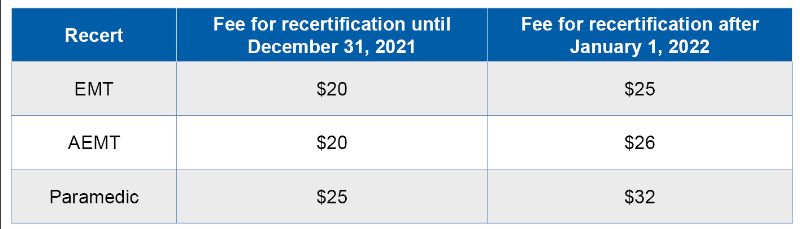
    Columbus, Ohio – August 6, 2021 – Recertification season will soon open for those EMTs, AEMTs and Paramedics due to recertify on March 31, 2022. As a new fee schedule will be introduced in the new year, the National Registry is encouraging registrants to take advantage of the current, lower recertification rate by completing the recertification process between October 1 and December 31, 2021.

    The new fee schedule is effective January 1, 2022, but hope this extended notice will allow those who are recertifying to take advantage of the lower fee option.

    Like all non-profit organizations whose business costs have grown, we have made every effort to minimize fee increases. At the heart of all that we do, you will find our commitment to the highest certification standards and supporting EMS professionals and their desired career path. Recertification fees cover vital operational and program development costs, which allow the National Registry to advance EMS Certification through our credentialing programs. 

  • National Registry Announces Update to Advanced Level Skill Sheets Effective March 17, 2021

    2021-03-09

    National Registry Announces Update to Advanced Level Skill Sheets Effective March 17, 2021 

    March 9, 2021 – Experienced providers sometimes interpret EKGs differently from one another. It is also true that paramedics, emergency physicians, cardiologists and primary care physicians have many different approaches to assessment and care that still leads to a positive outcome for the patient. For these reasons, the National Registry has revised the Advanced Level Psychomotor Examination Skill Sheets.  
     

    We are providing this information to help you prepare for the implementation of the revised Skill Sheets on March 17, 2021.  

    The “What”  

    Skill Sheets for the National Registry Advanced Level Psychomotor Examinations will have fewer critical criteria. In addition, the Static Cardiology skill will now allow candidates to receive points for the appropriate treatment of the patient, even if the rhythm interpretation is incorrect. This is a change from the previous “all or nothing” score for this skill station.  

    The “Why”  

    The National Registry continuously reviews its examinations to be certain that content is accurate, relevant and reflects current practice.  Best practice in test development encourages judicious use of critical criteria to eliminate “trap doors” which potentially cause a candidate to fail based on a simple error when they were otherwise demonstrating good performance. Critical criteria also cause candidates to focus too much on “what not to do” instead of focusing on appropriately managing the patient.  

    The National Registry recognizes that there is  variance in the way different healthcare providers assess and treat patients which all fall within nationally acceptable standards, hence the changes. 

    The “How”  

    The National Registry reviews its examinations with the help of Subject Matter Experts (SMEs), who are guided by accurate content, and current and relevant practice  to make recommendations to the National Registry. Critical criteria were reviewed by working EMS providers and have been simplified to more accurately reflect a focus on good patient care. Skill examiners still have the opportunity to report major clinical errors or behavioral issues to the National Registry Representatives who are responsible for scoring the candidate’s examination.   

     The “When”  

    This change impacts Advanced Level Psychomotor Examination candidates testing on or after March 17, 2021. Any candidate testing on or before March 16, 2021 will be evaluated using the current Skill Sheets. Both versions of the skill sheets are available on our website. Please review the ones pertinent to your examination.   

    Frequently Asked Questions (FAQs)  

    Q: Do the changes to the skill sheets mean that the skill examiner has more power, or is the candidate’s pass/fail status more reliant now on the skill examiner?  

    Skill examiners time the skill, provide the necessary information to candidates when prompted, and document candidate performance.  

    • Skill examiners do not determine whether the candidate passed or failed the skill.  

    • When critical criteria are marked, the National Registry Representative reviews them for documentation and accuracy.  

    • In some instances, the exam’s Medical Director may also weigh in on decisions related to critical criteria.   

    Q: Is this a change to the passing standard?  

    • The passing standard remains unchanged. The National Registry Representative will still assign a pass or fail to a candidate based on the scoring rubric, which was not modified.  

    • The removal of critical criteria simply removes trap doors for candidates who otherwise demonstrated acceptable performance.  

    Q: Why is unprofessional behavior a critical failure?  

    • Unprofessional behavior is a critical failure based on the input of SMEs and the expectations of the profession.  

    • This criterion allows the skill examiner a formal tool to alert National Registry Representative to inappropriate behavior.  

    Q: Do these changes impact the BLS skill sheets for EMR and EMT?  

    • No, only Advanced Level Psychomotor Examinations are impacted by this change.  

    • EMR and EMT psychomotor examinations are regulated by state EMS offices.  

    Q: Has anything other than the critical criteria changed on the skill sheets?  

    • There are a handful of very minor editorial changes to help skill examiners more efficiently assign points to a candidate.  

    • The American Heart Association update in 2020 published revised ventilatory rates. In response, the National Registry adopted the AHA 2020 ventilatory rate guidelines. Candidates are expected to adjust ventilations to patient response such as skin color, oximetry, and capnography.   

    Q: What if I have a concern about my evaluation?  

    • Immediately notify the National Registry Representative onsite during or after the occurrence.  

    • Complaints are not accepted after unofficial results are reported to the candidate.  

    On YouTube

    A video further explaining the Skill Sheet Revisions is available on the National Registry’s YouTube channel. 


  • ACS seeks feedback from EMS practitioners as it revises Field Triage Guidelines

    2021-01-17

    National Registry of Emergency Medical Technicians calls for robust participation by EMS personnel
    The American College of Surgeons Committee on Trauma (ACS COT), in collaboration with several key partner organizations, is leading the revision of the 2011 Field Triage Guidelines. As a part of the revision process, the ACS COT is seeking input on the current guidelines from a broad group of EMS stakeholders, at all certification levels and in all roles. With the goal of reaching as many EMS practitioners as possible, the ACS has reached out to the National Registry of Emergency Medical Technicians for input.

    The National Registry is encouraging EMS practitioners, including all its stakeholders, to provide feedback to the ACS that can be considered as it embarks on a revision of current Field Triage Guidelines.

    “The National Registry is uniquely positioned to reach a number of EMS professionals who can provide a broad range of input for the Field Triage Guidelines update,” said Bill Seifarth, executive director of the National Registry. “Our stakeholders include those providers working in the field each and every day – from Emergency Medical Responders to Paramedics.”

    Seifarth added that National Registry stakeholders also include medical directors, training officers, state EMS officials and more – all of whom would provide depth and breadth to the input being sought by the American College of Surgeons in their feedback tool.

    Eileen Bulger, MD, FACS, chair of the ACS COT explained that “the Field Triage Guidelines are essential to get the right patient, to the right place, at the right time to treat life-threatening injuries.  The guidelines are only useful if they can easily be applied by the EMS practitioner in the field.  We ask that all providers share their experience with the current guidelines by completing the feedback tool. Your input will directly impact the revision process.”

    The American College of Surgeons feedback tool contains approximately 40 questions and should take about 15 minutes to complete. All feedback should be provided by January 15, 2021.   The feedback tool can be found here: https://bisfacs.qualtrics.com/jfe/form/SV_1GqyCXIxTHc2JrD 

    Media Contact:

    Shane Cartmill
    Communications & Marketing Manager
    scartmill@nremt.org
  • National Registry launches new website

    2021-01-19

    Welcome to the new nremt.org! Launched January 19, 2021, the National Registry’s website is designed with you in mind.

    The new website arrives with a modern design and increased efficiency. It brings the ability to deliver you timely information and updates and it gives the National Registry flexibility that will allow it to focus IT resources on new projects.

    “As we turn the page from our 50th anniversary, we are looking to the future and how we can provide the best user experience for the EMS community,” said Bill Seifarth, executive director of the National Registry. “The next 50 years begins here, and we are proud to bring you an intuitive website that delivers fresh content and gives you easy access to the information you need.”

    “The new website will allow the National Registry to leverage true content management capabilities through a new Content Management System (CMS) which will assist us in delivering timely and relevant content to the EMS community, the media and the general public,” said Tad Rhodes, Director of Information Technology for the National Registry. “We understand that technology is the catalyst for growth and advancement, and the future is bright because of the investments we are making today.”

    The National Registry encourages everyone to familiarize themselves with new website. While all content from the old site has been transferred, the National Registry will continue to improve and update the new site. We will keep stakeholders apprised of any significant changes, additions and new features.

    Media Contact:
    Shane Cartmill
    Communications & Marketing Manager
    scartmill@nremt.org

  • National Registry’s EMS Practice Analysis Accepted For Publication

    2021-01-20

    COLUMBUS, OH – The National Registry announced that the 2019 EMS ALS Practice Analysis was accepted for publication by the National Association of EMS Physicians’ journal, Prehospital Emergency Care. This is an exciting step in providing the EMS community a clear vision of current care provided in the prehospital setting, including the tasks performed by EMS practitioners. The National Registry conducted the practice analysis for the Advanced Life Support levels (Paramedic and AEMT) in 2019 using data from multiple sources, including the National Emergency Medical Services Information System (NEMSIS), surveys from active EMS providers and recommendations from EMS subject matter experts. The BLS levels (EMR and EMT) Practice Analysis will be conducted in 2022. 

    “Through the practice analysis we wanted to clearly define the current daily practice of Paramedics and AEMTs so that it can inform examinations on a national level,” said Dr. Ashish R. Panchal, Research and Fellowship Director for the National Registry of EMTs and an EMS Physician at The Ohio State University. “This is why we used the largest available datasets, like NEMSIS, leveraging its over 25 million EMS activations across the United States. Globally, as we understand the changing dynamics of care, we can better focus on improving prehospital care.” 

    The 2019 EMS Practice Analysis will help inform many aspects of the EMS system, including the National EMS Educational Standards and National Registry certification exams.  

    Key Facts in the 2019 EMS Practice Analysis 

    • More than 3,500 EMS professionals were involved in the 2019 Practice Analysis, including staff, panel members and survey respondents. Data from 10,000 EMS agencies was included in the Practice Analysis.  
    • The most common adult impressions (requests for help) were traumatic injury, abdominal pain/problems, respiratory distress/arrest, behavioral/psychiatric disorder, and syncope/fainting 
    • The most common pediatric impressions were traumatic injury, behavioral/psychiatric disorder, respiratory distress/arrest, seizure, and abdominal pain/problems. 
    • The highest risk of harm for adults were identified as airway obstruction, respiratory distress/arrest, cardiac arrest, hypovolemia/shock, allergic reaction, or stroke/CVA 
    • In comparison, pediatric patients presenting with airway obstruction, respiratory distress/arrest, cardiac arrest, hypovolemia/shock, allergic reaction, stroke/CVA, and inhalation injury had the highest potential for harm. 
    • A total of 532 tasks (a unique activity performed by an EMS professional) and 2,290 associated knowledge, skills and abilities (KSAs) required to accomplish the task were defined for the Paramedic level.  
    • A total of 405 tasks and 1,636 KSAs were defined for the AEMT level. 

    Where to find the 2019 EMS Practice Analysis 
    The 2019 EMS Practice Analysis is available here, along with the abstract: https://www.tandfonline.com/doi/full/10.1080/10903127.2020.1856985 
      

  • National Registry Board Meeting – June 2020 Summary

    2020-06-05

    The National Registry Board of Directors met on June 4-5, 2020 for an abbreviated virtual meeting. The meeting only addressed essential business matters as highlighted below.

    • 50th Anniversary The National Registry of EMTs celebrated its 50th Anniversary on June 4th. The Board had a preview of an historical video highlighting various milestones of the National Registry’s history. That video is now available at this Link.
    • Organizational Update. The Board received a business briefing on the organization. Despite the pandemic, operations are continuing and the volume of examinations being administered continues to rise. The use of online proctoring and remote working have yielded positive returns for the organization and will play a role in the future “new norm.”
    • National Registry’s COVID-19 Response To Date. The Board and staff overviewed the organization’s COVID-19 actions taken to date:
      • Extended the recertification date for EMTs, AEMTs and paramedics from March 31, 2020 to June 30, 2020, including the Recertification by Examination (RBE) and audit response date. We also removed limits of distributive education. We did not extend a late reinstatement period for the 2020 recertification period. (20-MOTION-01. 03/12/2020)
      • Changed the course eligibility and examination validity dates from 24 months to 30 months for all candidates with course completion dates from March 2018 through August 2020 to compensate for the disruption in the testing network. (20-RESOLUTION-05; 03/19/2020)
      • Removed limits of distributive education for EMRs recertifying in 2020. (20-MOTION-08; 04/15/2020)
      • Issued provisional certifications for all candidates that had completed eligibility requirements, course completion and successfully completed the cognitive examination. All provisional certifications were issued with an expiration date of 12/31/2021 to provide sufficient time for completion of psychomotor examinations. At least twenty states are issuing limited state licenses based on provisional certification. (20-MOTION-03; 3/17/2020)
      • Initiated online proctoring examination for EMT and AEMT candidates starting on May 12. Also worked with Pearson VUE to have testing centers opened for essential personnel only (EMTs and nurses initially). (20-RESOLUTION-04; 03/19/2020)
    • Provisional certification and modified psychomotor examination. The Board discussed how long the provisional certification will continue to be in place and how long the modified ALS psychomotor examination will need to continue. As of now, it is too early to determine when either will be able to discontinue. The rapid, dynamic, and unpredictable nature of COVID-19 makes it currently difficult to put an “end date” with the provisional certification and the modified psychomotor examination.
    • Board Actions taken during Board meeting:
      • ALS Practice Analysis (20-MOTION-09). The Board received and approved the 2019 ALS practice analysis for AEMT and paramedic. The practice analysis is a snapshot of the AEMT and paramedic types and frequency of clinical presentations in prehospital care, the criticality or potential for harm of the clinical presentations, and the knowledge, skills and abilities that encompass care at the AEMT and paramedic levels.
      • EMR Certification Scheme (20-MOTION-10). The Board provided final approval of the EMR certification scheme for full implementation in March 18, 2021. The Board provided initial approval during its November 2019 meeting. The public comment period yielded nothing substantive. The EMR certification scheme centralizes and specifies the scope of the certification, job and task description, required competence, required abilities, prerequisites, and applicable code of conduct for EMR certification. The EMR certification scheme aligns with the certification schemes previously approved by the Board for EMT, AEMT, and paramedic.
      • Interstate Compact and Commission Support and Related Policy Development (20-RESOLUTION-12 and 13). The Board passed two resolutions with the first focused on the National Registry’s reaffirmation of its support of the EMS interstate compact and the Commission, as well as a resolution focused on finalizing the development of policies and procedures necessary to put the interstate compact database into full development.
      • New EMT at Large National Registry Board Director. The Board elected Mr. Braxton Morrison of Vinton, IA as its EMT-at-Large member. Mr. Morrison brings to the position his experience as a veteran of the United States Army, a nationally certified and state licensed paramedic, specialty EMS certifications, a certified Iowa law enforcement officer, and more. Mr. Morrison will officially assume his position during the upcoming National Registry Board meeting.

    ###

    National Registry of Emergency Medical Technicians Board of Directors Online Meeting Summary


  • National Registry Board Meeting – June 2019 Summary and Public Notice

    2020-06-12

    During the Board of Directors meeting, in additional to staff reports fiduciary oversight, the Board passed a number of motions and resolutions. A summary of the board meeting, the motions, and the resolutions are available at the link below.

    The Board has requested a 60-day stakeholder comment period for interested parties to comment on the motions and resolutions. All stakeholer comments will be reviewed and considered as the policies are implemented. Transparency and stakeholder input is essential to the National Registry. If you would like to comment on the proposed policy, please click here. The comment period will close on September 30, 2019.

    A summary of board actions follows:

    1. National Registry staff presented an update on Strengthening The Core to the Board of Directors. The organization wide Strengthening The Core initiative is critical to the future success of the National Registry. The three main components are:
      1. Information Technology Infrastructure Overhaul
        1. Addition of seven full-time employees.
        2. Utilization of the National Registry’s project manager to organize, plan and coordinate Strengthening The Core projects.
        3. Extending the timeline of already identified Strengthening The Core projects.
        4. Continued maintenance of the National Registry’s Information Technology infrastructure.
      2. Examination Improvement
        1. Technology Enhanced Items (TEI), computer-based simulation and interactive graphics providing options beyond multiple choice.
        2. A new Item Management System.
        3. Changes in scoring model
      3. Continued Competency
        1. Initiative to develop a national guidance document supporting a systems approach to Continued Competency. The national Registry board has voted to move forward on owning the National Continued Competency approach.
    2. The National Registry is performing an EMS Practice Analysis, a required element to demonstrate content validity for all four levels of the certification examination. The practice analysis defines the work performed in the prehospital setting, providing a context which informs test specification and ensures National Registry certification is compliant with NCCA accreditation and the Standards for Educational and Psychological Testing. The panels have been completed and the data analysis in process.
    3. The Science and Examinations team provided an update that included the addition of new examination sites and an improved accommodations process. With an evaluation of nearly half of the states complete, the National Registry has added 82 new test sites to help reduce drive time and travel distances for candidates. It also makes scheduling easier with the added locations and available times. Also, the National Registry, which meets ADA requirements, has created a checklist to help guide candidates through the process of requesting accommodations for National Registry examinations.
    4. The Operations team introduced two groups for the National Registry – Stakeholder Partnerships and Project Management. As the National Registry engages in strengthened and new relationships, the Stakeholder Partnerships team was created to liaise with the many organizations and stakeholders. Likewise, the number of projects related to Strengthening The Core and improving the customer experience required the oversight of a dedicated Project Manager.
    5. The Finance and Administration teams briefed the Board of Directors on the upcoming fee increase and the National Registry’s volunteer experience. For only the second time in the National Registry’s history, the certification fee is increasing by a modest $5 at each level. Also, a revamped volunteer database is in the works. The National Registry encourages volunteers from a variety of EMS backgrounds to assist as Item Writers, Panel Members and Exam Representatives.
    6. A streamlined and more efficient recertification process was announced by the Certification team. For 2019-2020, providers will assign continuing education to five general topic categories rather than the more than 30 subcategories currently required.
    7. The NREMT Board of Directors approved the following motions and resolutions:
      • 19-Resolution-03: Resolution on the National Registry of EMTs Board of Directors Support for Elimination of the Age Requirement. With no abstentions, the motion passed unanimously. This resolution eliminates age requirements (currently 18) for all certifications. As such, the National Registry will defer to states who already have age requirements in place.
      • 19-Resolution-04: Resolution on the National Registry of EMTs Board of Directors Support for the adoption of scaled score reporting in lieu of domain-level reporting of candidate examination results. With no abstentions, the motion passed unanimously.
      • 19-Resolution-05: Resolution on the National Registry of EMTs Board of Directors Support for adoption of technology enhanced item types on the cognitive examination. With no abstentions, the motion passed unanimously. This gives the National Registry flexibility to give more authentic items beyond the standard multiple choice items.
      • 19-Resolution-09: Resolution on the National Registry Board of Directors Support Recognition of Board-Certified EMS Physician training for National EMS Certification. With no abstentions, the motion passed unanimously. Recognizing that EMS fellows and board-certified EMS physicians have the equivalent to course completion of Paramedic certification and may set for the examination.
      • 19-Resolution-10: Resolution on the National Registry Board of Directors Support of Advanced Placement Pathway for National EMS certification. With no abstentions, this motion passed unanimously.
      • 19-Motion-11: The Standards and Examination Committee moves that the Board of Directors continue to support the Examinations Improvement Plan. With no abstentions, the motion passed (17-1).
      • 19-Motion-13: The Finance Committee moves that the Board of Directors approve the 2019 Amended Budget. With no abstentions, the motion passed unanimously.
      • 19-Motion-15: Resolution on the Merchandise Offered for Sale by the National Registry. With no abstentions, the motions passed unanimously.

    Click here to download the board action summary pdf document. 
    Click here to download the full text of the resolutions and motions in a pdf document. 
    Provide public comment or feedback on the motions and resolutions.