COLUMBUS, OH —July 29, 2020 — The Board of Directors of the National Registry of Emergency Medical Technicians (National Registry) is accepting applications for the Public Health At-large Board position with a term beginning November 2020.
National Registry board members serve four-year terms and are required to attend at least two in-person Board of Directors meetings each year. Members-at-large may also sit on up to three Board committees that require additional in-person meetings or conference calls.
Candidates for this position are expected to have demonstrable experience in Public Health leadership and administration. Previous involvement in National Registry initiatives or EMS experience is preferred.
To be considered for this board position, candidates should send a cover letter and CV to Board Nominations Committee Chair Robert Swor at board@nremt.org. Submissions received after August 31, 2020 will not be considered.
From the received applications, the Nominations Committee will select a slate of qualified candidates. Elections for this position will be held at the November 2020 meeting of the National Registry Board of Directors, and the term will begin immediately upon election.
NATIONAL REGISTRY BOARD MEMBER RESPONSIBILITIES
PURPOSE OF National Registry
The National Registry of Emergency Medical Technicians exists to serve as the National EMS Certification Organization. It accomplishes this purpose by providing a valid, uniform, legally defensible and psychometrically sound process to assess the knowledge and skills required for competent practice by EMS professionals throughout their careers and to maintain a registry of certification status.
RESPONSIBILITIES
Members of the Board of Directors are responsible for the oversight, strategic planning, policy development and financial well-being of the National Registry. Board members are expected to attend board meetings and scheduled committee meetings, and to participate in other National Registry duties as assigned. In addition, Board members are expected to come prepared for all meetings, reading all materials made available and be actively engaged in all discussions and decisions.
Board members have fiduciary responsibility to the National Registry and must exercise their duties of care, loyalty and obedience in all National Registry related business. Board members are independent members of the National Registry Board and must be cognizant of recognizing any potential conflicts of interests (whether real or perceived) to ensure that all decisions are made in the best interest of the National Registry. Although board members bring varied talent and expertise, they do not represent the interest of any other organization/stakeholder.
While debates and deliberations are necessary to ensure thoughtful and careful policies are made, Board members are expected to support final decisions made by the Board. In addition, confidential material shared with board members must remain strictly confidential and must not be shared with any outside party.
TERM
Term of office:
4 years (eligible for one additional four-year term)
Compensation:
None
Expenses:
The National Registry pays all reasonable travel expenses
TYPICAL ACTIVITIES
Year one:
(In addition to annual responsibilities)
Board orientation session with executive director (one day)
Item writing meeting, if possible (two and a half days)
Annually:
Board meetings typically held in June and November (one to two days each) Assigned committee meeting(s) (one to two days for three to five meetings) Periodic Board and committee conference calls, as needed
Occasionally:
Participate in subject matter expert meetings as required (Generally one in three years)
Columbus, Ohio – Do you want to make a lasting impact on the EMS community at a national level? Perhaps you have a passion for EMS research. The National Registry is conducting a nationwide search for a Research Manager who will be a key member of the National Registry Science and Examinations Team.
The Research Manager will hold an essential leadership role on the Science and Examinations Team, supporting and managing the Registry’s Research Program. The Research Manager will mentor and supervise Research Fellows and conduct original research that supports the National Registry’s mission to protect the public.
“This is an exciting time to be a part of the National Registry as we enter our 51st year as the nation’s EMS certification body,” said Bill Seifarth, executive director of the National Registry. “We are committed to making a difference in the lives and careers of EMS practitioners and this position will make a positive, lasting impact.”
The National Registry Board of Directors passed their final votes on four resolutions this afternoon. Specific to the resolution on eligibility, 22-Resolution-13, the board has voted to rescind the resolution on eligibility requirements and continue this conversation with national partners and key stakeholders to progress towards a more inclusive solution.
The eligibility criteria will remain as it is for now. Conversations will continue with a National Task Force comprised of representatives from national organizations. This task force can and will work collaboratively, with transparency, and with a vested interest in our broader national EMS community to further the conversation and explore solutions for the challenges facing our “EMS education systems” from the local to national levels.
We will provide updates from the National Task Force as it works to collaboratively address the concerns with the current CoAEMSP accreditation pathway while upholding the EMS Education Agenda for the Future: A Systems Approach.
In recognizing the ample feedback received from the 60-day public comment period, the decision-making process on all four resolutions was carefully deliberated and the voices of all partners, registrants, and EMS community were taken into consideration.
The remaining three resolutions were voted upon and passed by the board. Please see the following links for access to their summaries:
COLUMBUS, OH — 2 March 2018 — The Board of Directors of the National Registry of Emergency Technicians is seeking qualified applicants for the Educator-at-Large position. This position serves a four-year term and Directors are required to attend two Board of Directors meetings each year. Board members may also be requested to serve on committees, requiring additional meetings or conference calls.
Candidates for this position are expected to have demonstrable experience in provision of Emergency Medical Services education, leadership, and in the provision of emergency care. Previous involvement in National Registry initiatives is preferred. To be considered for either position, interested parties should send a cover letter and curriculum vitae to the Board Nominations Committee Chair, Debbi Cason, at board@nremt.org. Submissions received after March 31, 2018 will not be considered. From the received applications, the Nominations Committee will select a slate of qualified candidates. Elections will be held at the June meeting of the Board of Directors, and terms will be effective immediately.
About the National Registry of Emergency Medical Technicians
Since its founding in 1970, the National Registry of Emergency Medical Technicians (NREMT) has offered the nation assurance that the men and women providing emergency treatment in the out-of-hospital setting are capable of providing the care that patients and their loved ones deserve. As the Nation’s EMS Certification organization, the National Registry provides psychometrically-valid proof of entry-level competence for Nationally Certified EMS personnel through rigorous cognitive and psychomotor examinations. National EMS Certification is offered at four levels and must be maintained biennially by demonstrating continued education and skills competence. To date, the National Registry has certified more than 1.8 million EMS professionals.
Transparency, collaboration and stakeholder input are essential to the National Registry. As such, the National Registry now provides a 60-day stakeholder comment period to comment on the resolution. The comment period will end on August 17, 2022.
During the June 2021 meeting, the National Registry Board of Directors passed a number of motions and resolutions. Transparency, collaboration and stakeholder input are essential to the National Registry. As such, the National Registry provides a 60-day stakeholder comment period following the board meeting for interested parties to comment on the motions and resolutions related to National EMS Certification. The comment period will end August 23, 2021.
Click here to see a general overview of the policies, resolutions and updates.
Click here to review specific policies, resolutions and updates.
The National Registry of Emergency Medical Technicians announced this week that Dr. Greg Applegate, chief science officer, will step down at the end of May after accepting a position as the Vice President Certification for the Institute of Internal Auditors, an international certification organization based in Florida.
Dr. Applegate was named chief science officer in 2016 and has been instrumental in moving the National Registry forward through multiple projects and examination improvements, including the alignment of the EMS practice analysis with industry standards and standing up a live, remote-proctored examination at the beginning of the global pandemic that helped ensure a continual flow of EMS practitioners when the public desperately needed them.
“During his tenure with the National Registry, Greg strengthened an extraordinary department which has taken us to new heights,” said Bill Seifarth, chief executive officer of the National Registry. “His visionary leadership and steady guidance helped us navigate the challenges of the pandemic and major projects like the ALS redesign.”
The National Registry is in the midst of a significant improvement with its Advanced Life Support (ALS) examination, which was initiated by Dr. Applegate.
“One of my proudest accomplishments with the National Registry is the relationships developed with the EMS community – both personally and as an organization,” said Dr. Applegate. “I have great confidence in the National Registry team and the EMS community members who have come together to carry out the remainder of the ALS redesign plan.”
Applegate says he is confident in the ALS redesign because of the solid plan and the dedicated people working on it, both inside and outside of the National Registry.
“This vice president role at a global organization is a great opportunity for Greg that allows him to advance his career further and make a lasting imprint just as he has done for the National Registry,” said Seifarth. “Greg has laid the groundwork for his successor through the many improvements he led with the examinations and psychometric teams.”
The search for Applegate’s replacement is underway and the position has been posted on the National Registry’s website. In the interim, Seifarth will lead many of Applegate’s ongoing work, including ALS redesign.
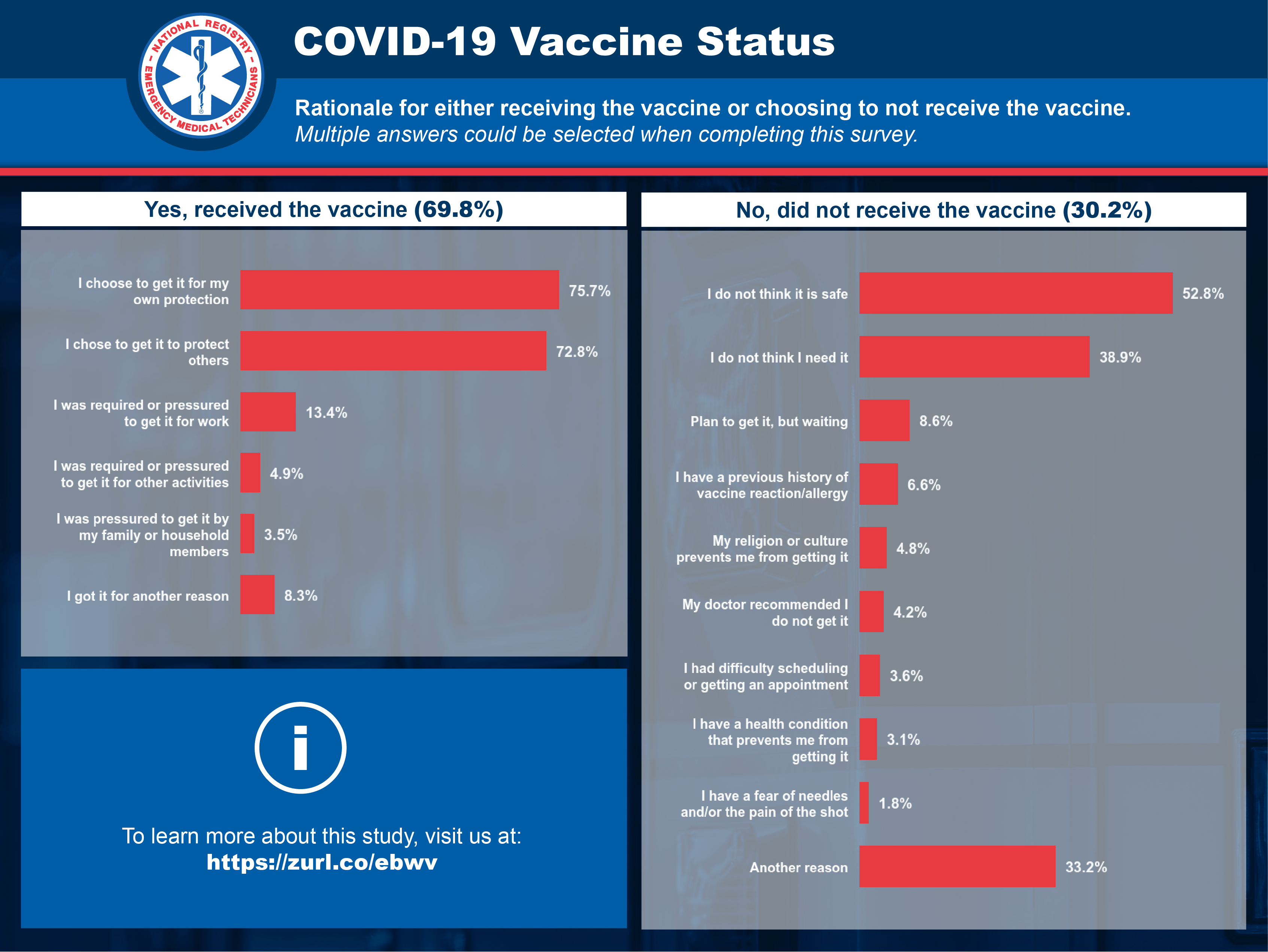
We are eager to share the results of the latest study conducted by the National Registry of Emergency Medical Technicians Research Team. This study examined EMS professionals’ beliefs about the COVID-19 vaccine. In April 2021, the research team conducted a study with 2,584 EMS professionals that showed a 70% vaccination rate against COVID-19.
Respondents were given multiple options as to why they chose to be vaccinated and could select as many that applied to them. 79% said they chose to do so to protect themselves, while 73% said they got vaccinated to protect others.
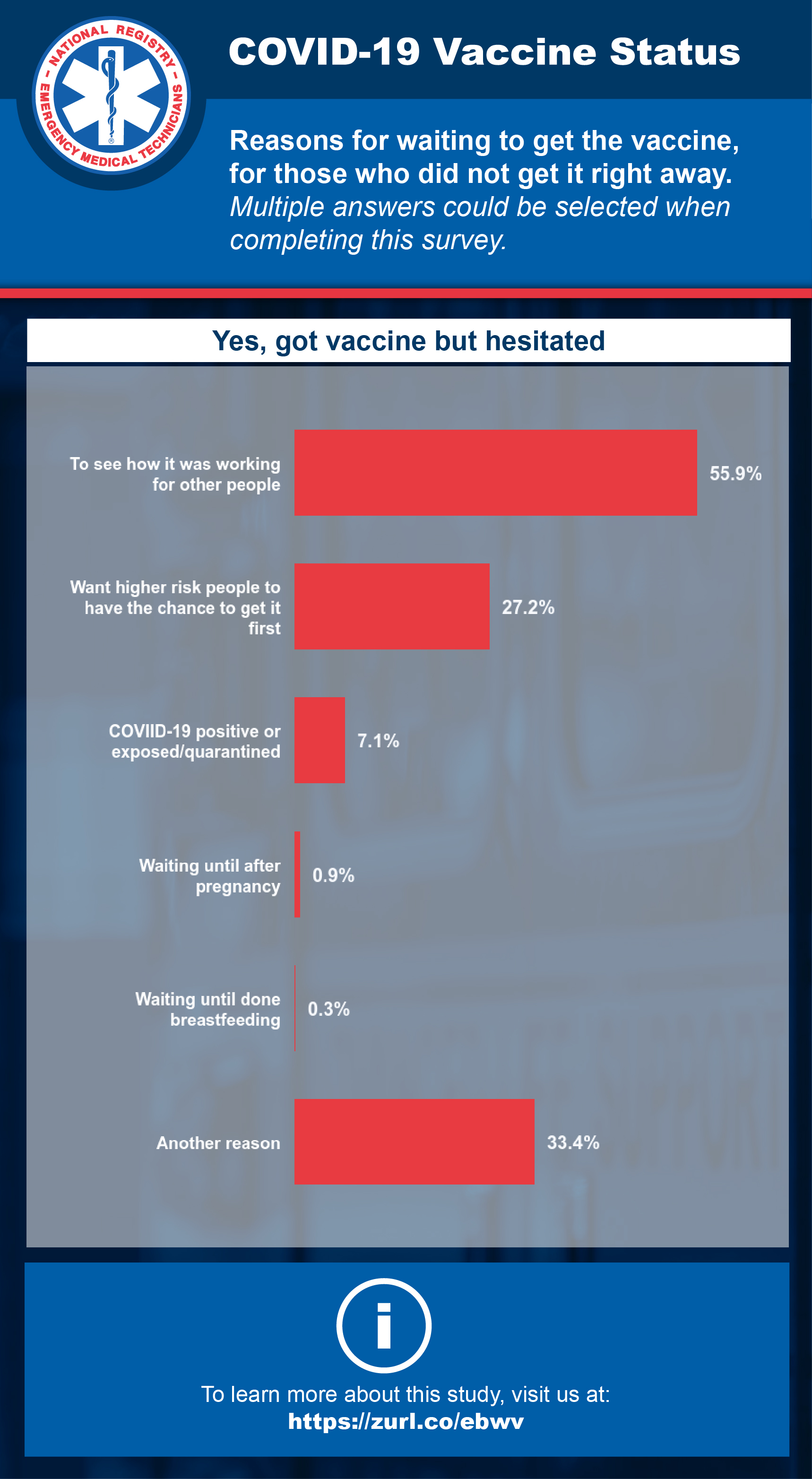
For the unvaccinated respondents, 53% cited concerns about the vaccine’s safety, and 39% felt that it was not necessary. Of the respondents who were initially hesitant but ended up getting the vaccine, the most stated reason for the initial hesitation was that they wanted to see how it would play out for others.
The odds of vaccination were significantly higher for respondents who felt a greater perceived risk from COVID-19. The strongest predictors of vaccination were increased age, living in an urban or suburban area, and having a bachelor’s degree or higher. Interested in reading more? The complete study can be found here.
Ohio State and National Registry of EMTs research highlights importance of public’s help in opioid overdose response
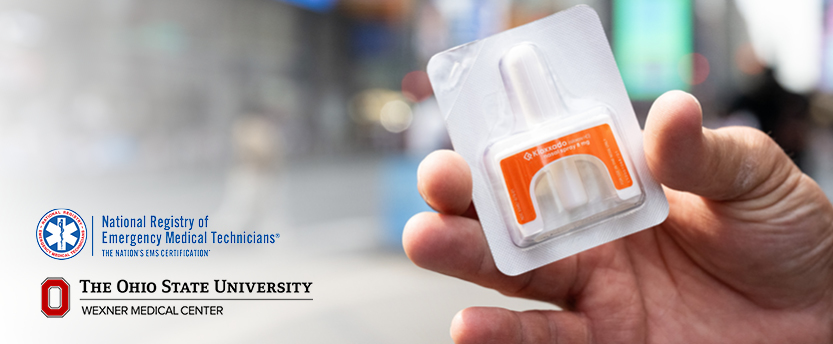
COLUMBUS, Ohio – Use of a lifesaving drug to reverse opioid drug overdoses is growing, but not fast enough. That’s according to new research in JAMA Network Open from The Ohio State University College of Medicine, College of Public Health and the National Registry of Emergency Medical Technicians.
In the first study of its kind, the research team looked at national use of naloxone by people without medical training to treat an opioid drug overdose.
“Naloxone is a lifesaving medication that can reverse opioid overdose effects when given immediately,” said Ashish R. Panchal, MD, PhD, clinical professor of emergency medicine and senior author. “Similar to CPR, stepping up to help before emergency crews arrive can be the difference between life and death.”
The study team evaluated two years of data from the National Emergency Medical Services Information System, the national emergency medical services (EMS) patient care record database. From June 2020 to June 2022, there were more than 96 million EMS activations from nearly 14,000 agencies across 54 states and U.S. territories. EMS reported 744,078 patients receiving naloxone with 24,990 of them getting it from an untrained bystander before EMS arrived.
“Our findings revealed that people receiving naloxone from laypersons increased by 43.5% proving that public health efforts are working,” said Chris Gage, PhD student at the College of Public Health and corresponding author.
In the past 10 years, there have been a growing number of public awareness campaigns and improved access to naloxone for people without medical training. Last year, the Food and Drug Administration approved naloxone for over-the-counter use. Forty-six states and the District of Columbia provide legal immunity for Good Samaritans who help people experiencing an opioid overdose.
“Unfortunately, the study found there is more work to be done since only 3.4% of EMS activations involving naloxone received it from non-medical bystanders,” said Gage. “In a perfect world, this should be closer to a 100% highlighting a need to improve naloxone education, enhance access and investigate and remove obstacles to its use.”
Future research will focus on the groups that are providing bystander naloxone and trying to understand delivery to patients in need.
Additional Ohio State authors are Jonathan Powell; Alexander Ulintz, MD; Michael Lyons, MD; and Henry Wang, MD.
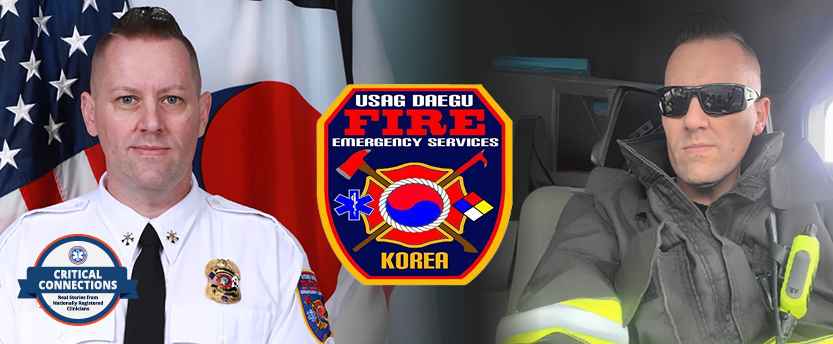
From an air base fire station in South Korea, Assistant Chief and Emergency Medical Technician (EMT) Michael Visser was the first person to complete National Registry of Emergency Medical Technicians (National Registry) recertification for the 2024-2025 cycle. This achievement underscores Visser’s dedication to staying ahead in the fast-paced, ever-evolving world of Emergency Medical Services (EMS). With a career spanning more than 25 years, Visser’s commitment to continuous education and professional development has been a key factor in his success, allowing him to rise through the ranks and take on leadership roles around the world.
A Journey Rooted in Education and Certification
Chief Visser’s EMS career began in 1997 when he earned his first EMT certification through Rio Hondo Fire Academy in California. From there, his career took him across state lines and even overseas, working with various military and civilian fire departments. In 2015, he earned his NREMT certification—a decision that opened the doors to greater flexibility in his career.
“As a Nationally Registered EMT, it allows me to travel the world with ease, and it opens doors to places once not attainable with only a state certification,” explains Visser. “Being nationally registered, I’ve been able to work in Texas, Virginia, Alaska, and now Daegu, South Korea. Having the ability to take the same certification anywhere, without having to take a test and pay more money each time, makes big changes easier.”
Why National Registry Certification Matters
For Visser, the importance of holding a National Registry certification goes beyond just career mobility. It represents a standardized level of excellence recognized across the United States and internationally, ensuring that EMTs like him can meet the demands of different regions and protocols without having to go through redundant testing or training.
“Being nationally registered opens so many doors,” says Visser. “It’s not just about being able to move from one state to another—it’s about knowing that wherever you go, you’re held to the same high standards of care.”
This standard has been especially beneficial to Visser, who has spent much of his career working on military bases for the U.S. Army, Navy, Marines, and Air Force. Whether stationed in Texas or South Korea, his National Registry certification ensures he can operate at the same level of competency, no matter where the job takes him.
The Importance of Lifelong Learning in EMS
Beyond certification, Chief Visser is a firm believer in the power of continuous education. In a field as dynamic as EMS, where new techniques, equipment, and protocols are constantly being developed, staying updated is crucial to providing the best possible care.
“Everything changes,” Visser notes. “As first responders, we learn new ways to do the same job all the time. Staying on top of the best lessons learned or a new technique is, in my mind, a best practice. It’s how we do better for our team and for safety. Taking care of your customers—your patients—should be your first priority, and you can only do that if you’re the best trained and educated to your local protocols.”
The National Registry, according to Visser, plays an essential role in this ongoing education. Recertification helps ensure that EMTs across the country are prepared to handle the latest challenges and standards in emergency care.
“It’s about doing better for your team and, ultimately, for your patients,” says Visser. “The National Registry plays a crucial role in helping us do better.”
Advice for New EMS Personnel: Stay Curious and Ask Questions
For those just starting out in EMS, Chief Visser offers simple but powerful advice: stay curious and never hesitate to ask questions. Whether it’s during training or on the job, he encourages new EMTs to seek out every opportunity to learn and grow.
“If you want to be the best at what you do, ask all the questions you can, even if you think they’re dumb,” says Visser. “Nine times out of ten, everyone else wants to know the same thing. Don’t fear the unknown—take it as a challenge. Treat knowledge like Legos—strive to get every question answered so you can be the best for your team and patients.”
Visser’s emphasis on curiosity reflects his own career, where he has continuously sought to expand his skills and adapt to new environments. His approach has not only allowed him to excel in EMS but also made him a valuable mentor to others in the field.
A Career Shaped by Military Service
Over the course of his career, Chief Visser has worked on 11 different military bases, gaining experience in various environments and learning from a diverse range of professionals. His time with the U.S. Army, Navy, Marines, and Air Force has given him a broad perspective on EMS and firefighting, helping him become a more effective leader.
“The best thing about working on military bases is all the people who I’ve learned from and helped mentor,” says Visser. “I’ve worked for four branches, and it’s opened my eyes to so many different ways of doing the same job. I’ve gained knowledge and life experiences I wouldn’t have had if I stayed put in one small town. The military fire service has broadened my horizons in ways I couldn’t have imagined.”
Visser’s experience in the military fire service also allowed him to take the skills he learned early in his career—starting as a Fire Explorer with the Los Angeles County Fire Department—and apply them on a much larger, more global scale.
Final Thoughts: The National Registry Makes It Easy to Stay on Track
For Chief Visser, one of the greatest advantages of the National Registry is its ease of use, particularly when managing certifications from remote or international locations. The National Registry’s online resources have made it possible for him to keep track of his recertifications, no matter where his career takes him.
“Thank you to the National Registry for the recent upgrades to their website,” says Visser. “It’s so easy now to keep track of everything and be anywhere in the world while keeping things up to date!”
In a profession where the stakes are high and the demands are ever-changing, Chief Visser’s career is proof that staying educated and maintaining National Registry certification are two keys to long-term success and the highest quality of care for the communities served.