
Author: Matt

  • NREMT Launches Recert2.0

    2017-09-08

    COLUMBUS, OH — 08 September 2017 — The National Registry of Emergency Medical Technicians is excited to announce today’s launch of Recert2.0, the largest update ever of the NREMT’s recertification system.

    Along with popularly requested features, such as an expanded certification dashboard and the ability for EMS personnel to affiliate with multiple EMS agencies, Recert2.0 also introduces the EMS Education Transcript, a powerful tool for tracking, storing, and managing continuing education.

    A secure hub for all of an EMS professional’s educational achievements, the EMS Education Transcript allows a user to add and import an unlimited number of continuing education entries and create an individualized, comprehensive professional record.

    “Emergency Medical Services is a rapidly-evolving profession, and a provider’s ability to always provide safe and competent care in the out-of-hospital setting often depends on robust continuing education,” said NREMT Interim Executive Director Drew Dawson. “Recert2.0 was developed with the importance of career-long development and learning in mind.”

    Whether taken online, at a conference or at a university, courses on any EMS topic can be easily added to the EMS Education Transcript. Users can upload supporting documentation (including PDFs and images of course certificates) and add important data such as the location and date of the course. To make each transcript uniquely personal, users are also able to add custom notes on each course.

    Courses, certificates and other credentials entered in the EMS Education Transcript can then be easily mapped to a provider’s NREMT recertification application. In most instances, the NREMT.org system will apply transcript entries to the correct recertification category automatically.

    “It is our hope that Recert2.0 will become an invaluable tool for EMS professionals both during their NREMT recertification periods and on every other day of their career,” said NREMT Chief Information Officer Donnie Woodyard.

    All Recert2.0 features are available immediately and at no cost to all Nationally Certified EMS personnel. The new recertification application will be available during the upcoming recertification period beginning October 1.


    The mission of the National Registry of EMTs is to serve as the National EMS Certification organization by providing a valid, uniform process to assess the knowledge and skills required for competent practice by EMS professionals throughout their careers and by maintaining a registry of certification status.

    ###

    Media Contact:

    Shane Cartmill
    Communications & Marketing Manager
    scartmill@nremt.org

  • National Registry Board Announces Scholar Position in Honor of Dr. Craig Manifold

    2020-11-13

    COLUMBUS, OHIO – The Board of Directors of the National Registry of Emergency Medical Technicians today announced the dedication of an existing EMS research scholar position in honor of the late Dr. Craig Manifold, a distinguished member of the National Registry Board since 2014. This was unanimously approved by the Board of Directors during its November board meeting.  

    The newly dedicated position will be called the Dr. Craig Manifold EMS Research Scholar and will be filled by an EMS professional who is selected to complete a research fellowship at the National Registry. The scholar will be a full-time employee of the National Registry, while receiving fully funded tuition towards completion of an approved doctoral program, through a partnership with The Ohio State University.

    “We are proud to honor the contributions of Dr. Manifold in a way that will continue his legacy,” said Dr. Heather Davis, chair of the National Registry’s Board of Directors. “The work performed by our research fellows directly impacts and shapes the future of prehospital care and emergency medical services, something we know Dr. Manifold was very proud of.” 

    Dr. Craig Manifold, who died suddenly in September, was an invaluable member of the EMS community, serving on the National Registry’s Board as well as being the Past Chair of the National Registry’s Research Committee and its International Committee. Dr. Manifold also was the Medical Director of NAEMT, the medical director for several EMS agencies in the San Antonio area and an assistant professor at the University of Texas Health Science Center in San Antonio.  He served on the South Texas Regional Advisory Council (STRAC), American College of Emergency Physicians, and Governors EMS and Trauma Advisory Committee as well as other boards in Texas and nationwide. 

    Media Contact:

    Shane Cartmill
    Communications & Marketing Manager
    scartmill@nremt.org
  • National Registry of EMT’s Resource Document on Spinal Motion Restriction/Immobilization

    In consideration of the new evidence and recent discussion concerning spinal immobilization, the National Registry of Emergency Medical Technicians (NREMT) has completed a review of the available published documents to date, including the resources listed below 1-7. The NREMT Standards & Examination Committee has discussed the impact of the recommended changes to our national EMS certification materials. This is not meant to be a clinical care document, rather to give guidance to testing candidates regarding NREMT’s interpretation of the literature on this topic. The NREMT will be implementing associated recommendations as of September 1, 2016.

    Traumatic spinal cord injuries occur rarely. However, the associated morbidity and mortality from these injuries are high. Historically, concern for delayed paralysis and missed cervical spine fractures resulted in the widespread application of spinal immobilization practices for trauma patients in the out-of-hospital setting. Included in this practice is the use of long backboards, cervical collars, head blocks, straps and other devices for spinal immobilization.

    Previously, the terms spinal immobilization and restriction have both been used to describe the act of preventing movement of the spine. Spinal motion restriction is defined as attempting to maintain the spine in anatomic alignment and minimizing gross movement irrespective of adjuncts or devices. NREMT’s use of the term, spinal immobilization is defined as the use of adjuncts (i.e cervical collar, long board, etc.) being applied to minimize movement of the spinal column.

    The benefit of spinal immobilization in most trauma patients is unproven. A growing body of evidence has suggested the use of a long backboard can result in harm to patients including agitation, pain, increased radiography, pressure sores, tissue ischemia, aspiration and respiratory compromise. Additionally, data suggests spinal column movement may not decrease when compared to placing a patient on a gurney. Thus, the criteria for the application of spinal precautions though unproven but generally accepted and prudent, should continue to be updated to follow validated, evidence-based indications.

    Patients for whom spinal motion restriction should be considered include those who have sustained blunt trauma through a high-energy mechanism and any of the following:

    • Altered level of consciousness
    • Drug or alcohol intoxication
    • Inability to communicate
    • Spinal column pain and/or tenderness
    • Neurologic complaints (e.g., numbness or motor weakness)
    • Anatomic deformity of the spine
    • Distracting injury (injuries so severely painful that neck examination is unreliable, [e.g., severe thoracic trauma, long bone fractures, crush injuries, large burns])

    In these individuals, a cervical collar should be applied. Long board use should be considered weighing the possible complications against the patient’s clinical situation.

    Spinal motion restriction may be considered specifically for patients who meet criteria such as the NEXUS criteria 6 and Canadian C-spine Rule7, which have been validated for use in emergency departments to identify patients at low risk for spinal injury.

    Further, concerning patients who have experienced penetrating trauma, spinal motion restriction using a long backboard should be used only if there are signs or symptoms of spinal injury.8 EMS personnel must specifically report when penetrating injuries are covered by application of a cervical collar or other adjuncts.

    The criteria for application of spinal motion restriction will continue to evolve and develop as further research is completed to optimize patient safety. Further, these criteria may require modification for specialty situations (i.e. military, contact sports, racing, etc). EMS providers should carefully assess trauma patients for the potential of spinal injury and minimize spinal motion in at risk patients.

    REFERENCES

    1. EMS spinal precautions and the use of the long backboard. Prehospital Emergency Care. July 2013;17(3):392-393.
    2. White C, Domeier R, Millin M. EMS spinal precautions and the use of the long backboard – resource document to the position statement of the National Association of EMS Physicians and the American College of Surgeons Committee on Trauma. Prehospital Emergency Care. April 2014;18(2):306-314.
    3. American College of Emergency Physicians. EMS Management of Patients with Potential Spinal Injury. ACEP Policy Statements. Available at: https://www.acep.org/clinical—practice-management/ems-management-of-patients-with-potential-spinal-injury/. Accessed July 27, 2016.
    4. National Association of State EMS Officials. National Model EMS Clinical Guidelines: Spinal Care. Available at: https://nasemso.org/Projects/ModelEMSClinicalGuidelines/documents/National-Model-EMS-Clinical-Guidelines-23Oct2014.pdf. Accessed July 27, 2016.
    5. Alson R, Copeland D. Long Backboard Use for Spinal Motion Restriction of the Trauma Patient. International Trauma Life Support. 2014
    6. Hoffman J, Mower W, Wolfson A, Todd K, Zucker M. Validity of a set of clinical criteria to rule out injury to the cervical spine in patients with blunt trauma. National Emergency X-Radiography Utilization Study Group. The New England Journal of Medicine. July 13, 2000;343(2):94-99.
    7. Stiell I, Wells G, Worthington J, et al. The Canadian C-spine rule for radiography in alert and stable trauma patients. JAMA. October 17, 2001;286(15):1841-1848.
    8. Lance E. Stuke, MD, MPH, Peter T. Pons, MD, Jeffrey S. Guy, MD, MSc, MMHC, Will P. Chapleau, RN, EMT-P, Frank K. Butler, MD, Capt MC USN (Ret), and Norman E. McSwain, MD. Prehospital Spine Immobilization for Penetrating Trauma—Review and Recommendations From the Prehospital Trauma Life Support Executive Committee. The Journal of Trauma Injury, Infection, and Critical Care, September 2011, 71(3), 763-770.

    Click here to download the pdf document.

  • How Clinical Guidelines Impact the National Registry

    2020-11-12

    The American Heart Association (AHA) recently updated CPR guidelines with an emphasis on recovery, especially after sudden cardiac arrest. The 400+ updates also address overdoses, new technology and an effort to increase awareness of the importance of high-quality bystander CPR.

    For the AHA, this comprehensive update builds on focused annual guideline updates, adopted for continuous evidence review since 2015. Similarly, the National Registry’s examinations are constantly undergoing review, updates and changes to best reflect the current practice in EMS. That means monitoring clinical guidelines from the AHA, American College of Emergency Physicians (ACEP), the Centers for Disease Control and Prevention, the American College of Surgeons and many, many more.

    When updates are released from any of these organizations, National Registry program managers immediately go through the updates to make sure there is nothing on the current examinations that is in direct conflict.

    The content review begins a process of identifying and removing any conflicting content. That is followed by a broader sweep of the National Registry’s item bank to remove any content that may conflict with any new or updated guidelines. At the same time, the National Registry uses practicing EMS providers, educators, and medical directors to develop new content and items. These items will ultimately make their way to the Cognitive and Psychomotor examinations after extensive review.

    “New content takes time to develop – as long as 6 to 12 months,” said Dr. Gregory M. Applegate, chief science officer for the National Registry. “The time window is important because it gives EMS programs time to begin incorporating the new guidelines into their curriculum and students time to learn the new material prior to encountering it on a National Registry examination.”

    The National Registry also must be aware of guidelines which may conflict with one another. As a result, the National Registry is working with the Prehosptial Guidelines Consortium on methods to better align published evidence-based guidelines with National Registry standards.

    ###

    Media Contact:

    Shane Cartmill
    Communications & Marketing Manager
    scartmill@nremt.org

  • Douglas Kupas, MD Receives 2020 Rocco V. Morando Lifetime Achievement Award

    2020-09-16

    COLUMBUS, OH — Douglas F. Kupas, MD, FAEMS, FACEP, was recognized with the 2020 Rocco V. Morando Lifetime Achievement Award for his lifetime of commitment, contributions and leadership to Emergency Medical Services (EMS). The award is NAEMT’s most prestigious and is generously sponsored by the National Registry of Emergency Medical Technicians (National Registry). The presentation was made during NAEMT’s annual General Membership Meeting held virtually on Sep. 15.

    Dr. Kupas is director of Mobile Integrated Healthcare for Geisinger Health System, his professional home for the past 30 years. He is an EMS physician, Professor of Emergency Medicine, Resuscitologist and the EMS Medical Director for the State of Pennsylvania for the past 20 years. A board-certified emergency physician subspecializing in EMS, Dr. Kupas is an avid researcher and passionate advocate for EMS practitioner and patient safety. His clinical interests include CPR, hypothermia, end-of-life care, EMS patient and practitioner safety and EMS airway management.

    National Registry Board Chair Heather Davis said, “For Dr. Kupas, like Rocco Morando, there is no such thing as status quo. We are either getting better or we’re getting worse. Both of these gentlemen are about using their gifts of wisdom and innovation, and the care they provide to patients, to make EMS better for both patients and providers.”

    Dr. Kupas’s EMS career began 40 years ago when he joined Lower Kiski Ambulance Services in Leechburg, PA, on his 16th birthday as a volunteer. He later became a paramedic and then a physician. He earned his medical degree from Thomas Jefferson University and completed his residency and emergency medicine residency at Geisinger Medical Center in Danville, PA.

    Since then, he has only moved forward. Dr. Kupas serves as the associate chief academic officer for Geisinger’s Medical Student and Resident Affairs, assistant dean for medical student affairs at the Temple University School of Medicine at the Geisinger Clinical Campus, and an associate at Geisinger’s Department of Emergency Medicine. He is a member of many local, state and national organizations and has numerous honors, awards and publications to his credit, including development of an anonymous patient safety event reporting system.

    NAEMT President Matt Zavadsky said, “Dr. Kupas has had a ‘storybook’ EMS career beginning as a volunteer at the age of 16. He has revolutionized EMS throughout his career, leading advanced in cardiac care, breaking bad news to families of cardiac arrest victims, helping to advance mobile integrated healthcare and ambulance safety and operations. It is a privilege to bestow this honor to Dr. Kupas!”

    Media Contact:

    Shane Cartmill
    Communications & Marketing Manager
    scartmill@nremt.org

  • The National Registry Mourns the Loss of a Valued Member of Our Board of Directors

    2020-09-21

    COLUMBUS, OH — It is with great sadness that the National Registry of Emergency Medical Technicians announces the death of Board Member Dr. Craig Manifold.

    Dr. Manifold was an invaluable member of the EMS community and was an especially cherished member of the National Registry family having served on our Board of Directors since 2014. Additionally, he was the Past Chair of the National Registry’s Research Committee and its International Committee.

    “We knew Dr. Manifold as a gentle leader, a persistent advocate and trusted member of the national EMS community,” said Heather Davis, Chair of the Board of Directors for the National Registry. “More importantly, though, he was our friend and I ask that you keep Dr. Manifold’s family in your dearest thoughts and prayers.”

    Dr. Manifold served the EMS community in many roles – as the Medical Director of NAEMT, the Medical Director in San Antonio and an assistant professor at the University of Texas Health Science Center in San Antonio. He served on many boards, both in Texas and nationwide. Dr. Manifold served on the South Texas Regional Advisory Council (STRAC), American College of Emergency Physicians, and Governors EMS and Trauma Advisory Committee.

    Having earned the rank Brigadier General (Retired), Dr. Manifold also served as Joint Surgeon for the Texas Air National Guard, and Commander for the 149th Medical Group of the Texas Air National Guard in San Antonio.

    The National Registry offers its condolences to the family of Dr. Craig Manifold, his friends, colleagues and all the organizations to whom he contributed so much during his career.

    Media Contact:

    Shane Cartmill
    Communications & Marketing Manager
    scartmill@nremt.org

  • National Registry of Emergency Medical Technicians Board of Directors Online Meeting Summary

    2020-06-08

    COLUMBUS, OH June 04-05,2020 —The National Registry Board of Directors met on June 4-5, 2020 for an abbreviated virtual meeting. The meeting only addressed essential business matters as highlighted below

    • 50th Anniversary The National Registry of EMTs celebrated its 50th Anniversary on June 4th. The Board had a preview of an historical video highlighting various milestones of the National Registry’s history. That video is now available at this Link.
    • Organizational Update. The Board received a business briefing on the organization. Despite the pandemic, operations are continuing and the volume of examinations being administered continues to rise. The use of online proctoring and remote working have yielded positive returns for the organization and will play a role in the future “new norm.”
    • National Registry’s COVID-19 Response To Date. The Board and staff overviewed the organization’s COVID-19 actions taken to date:
      • Extended the recertification date for EMTs, AEMTs and paramedics from March 31, 2020 to June 30, 2020, including the Recertification by Examination (RBE) and audit response date. We also removed limits of distributive education. We did not extend a late reinstatement period for the 2020 recertification period. (20-MOTION-01. 03/12/2020)
      • Changed the course eligibility and examination validity dates from 24 months to 30 months for all candidates with course completion dates from March 2018 through August 2020 to compensate for the disruption in the testing network. (20-RESOLUTION-05; 03/19/2020)
      • Removed limits of distributive education for EMRs recertifying in 2020. (20-MOTION-08; 04/15/2020)
      • Issued provisional certifications for all candidates that had completed eligibility requirements, course completion and successfully completed the cognitive examination. All provisional certifications were issued with an expiration date of 12/31/2021 to provide sufficient time for completion of psychomotor examinations. At least twenty states are issuing limited state licenses based on provisional certification. (20-MOTION-03; 3/17/2020)
      • Initiated online proctoring examination for EMT and AEMT candidates starting on May 12. Also worked with Pearson VUE to have testing centers opened for essential personnel only (EMTs and nurses initially). (20-RESOLUTION-04; 03/19/2020)
    • Provisional certification and modified psychomotor examination. The Board discussed how long the provisional certification will continue to be in place and how long the modified ALS psychomotor examination will need to continue. As of now, it is too early to determine when either will be able to discontinue. The rapid, dynamic, and unpredictable nature of COVID-19 makes it currently difficult to put an “end date” with the provisional certification and the modified psychomotor examination.
    • Board Actions taken during Board meeting:
      • ALS Practice Analysis (20-MOTION-09). The Board received and approved the 2019 ALS practice analysis for AEMT and paramedic. The practice analysis is a snapshot of the AEMT and paramedic types and frequency of clinical presentations in prehospital care, the criticality or potential for harm of the clinical presentations, and the knowledge, skills and abilities that encompass care at the AEMT and paramedic levels.
      • EMR Certification Scheme (20-MOTION-10). The Board provided final approval of the EMR certification scheme for full implementation in March 18, 2021. The Board provided initial approval during its November 2019 meeting. The public comment period yielded nothing substantive. The EMR certification scheme centralizes and specifies the scope of the certification, job and task description, required competence, required abilities, prerequisites, and applicable code of conduct for EMR certification. The EMR certification scheme aligns with the certification schemes previously approved by the Board for EMT, AEMT, and paramedic.
      • Interstate Compact and Commission Support and Related Policy Development (20-RESOLUTION-12 and 13). The Board passed two resolutions with the first focused on the National Registry’s reaffirmation of its support of the EMS interstate compact and the Commission, as well as a resolution focused on finalizing the development of policies and procedures necessary to put the interstate compact database into full development.
      • New EMT at Large National Registry Board Director. The Board elected Mr. Braxton Morrison of Vinton, IA as its EMT-at-Large member. Mr. Morrison brings to the position his experience as a veteran of the United States Army, a nationally certified and state licensed paramedic, specialty EMS certifications, a certified Iowa law enforcement officer, and more. Mr. Morrison will officially assume his position during the upcoming National Registry Board meeting.

    National Registry of Emergency Medical Technicians Board of Directors Online Meeting Summary

    ###

    Media Contact:

    Shane Cartmill
    Communications & Marketing Manager
    scartmill@nremt.org

     
  • ROCCO MORANDO LIFETIME ACHIEVEMENT AWARD

    2018-10-30

    COLUMBUS, OH — CoTCCC Chair Dr. Frank Butler Receives NAEMT’s Most Prestigious 2018 Rocco V. Morando Lifetime Achievement Award.

    Clinton, Miss. — Captain Frank K. Butler, Jr., (USN ret), MD was presented with the 2018 Rocco V. Morando Lifetime Achievement Award, recognizing a lifetime of commitment, contributions and leadership to Emergency Medical Services (EMS). The award is NAEMT’s most prestigious and is generously sponsored by the National Registry of Emergency Medical Technicians (NREMT). The presentation was made during NAEMT’s annual General Membership Meeting in Nashville on Oct. 30.

    Dr. Butler has conducted, promoted and applied the results of military health system research in his roles as a founder of Tactical Combat Casualty Care (TCCC) and Director of the Prehospital Care Branch of the Joint Trauma System and the Department of Defense Center of Excellence for Trauma.

    Bill Seifarth, Executive Director of NREMT remarks, “Dr Butler has contributed greatly to the medical field, in particular the military medicine. His focus and attention to detail has resulted in many advancements, namely championing addressing preventable deaths. His systematic approach transferred the knowledge gained from the battlefield to the civilian arena. As a result, more lives are being saved… everyday.”

    Dr. Butler’s work in trauma care was first recognized in 1996 when he co-authored a landmark paper in a Military Medicine journal which introduced the concept of TCCC. As a guideline customized for use on the battlefield, TCCC aimed to address preventable causes of combat death by optimizing care given prior to arrival to a fixed medical facility. An important innovation proposed in the paper was recognition of the need in battle to rectify both good tactics and good medicine. The TCCC guidelines were first adopted by U.S. Special Operations Command, Navy SEAL Teams, Army Rangers, and Air Force Pararescue and endorsed by the American College of Surgeons Committee on Trauma and NAEMT. The guidelines, updated every year, are now followed by combat medics, forward operating bases, medical evacuation teams and surgeons in both the military and civilian sectors in the U.S. and abroad.

    Dennis Rowe, President of NAEMT states, “Dr. Butler’s name is synonymous with prehospital and battlefield trauma care. He has dedicated his life’s work to ensuring medics are trained to the highest possible standard for combat medical providers, and that they have the full support of their senior medical providers and line commanders. Dr. Frank Butler is a most deserving recipient of this award and we are grateful for his lifelong efforts and dedication to advance the medical care of those who bravely serve our country in all military branches.”

    Rocco Morando Lifetime Achievement Award 

    Media Contact:

    Shane Cartmill
    Communications & Marketing Manager
    scartmill@nremt.org

  • REPLICA Names Commission Honorary Chairs

    2017-09-20

    REPLICA member states have selected NREMT Board Chair Debra Cason to serve as an honorary chair of the first meeting of the Interstate Commission for EMS Personnel Practice. The inaugural meeting will be held Oct. 7-8 in Oklahoma and will be open to the public. Read the full release below.

    FALLS CHURCH, VA — 20 September 2017 — Representatives from member states (Alabama, Colorado, Georgia, Idaho, Kansas, Mississippi, Tennessee, Texas, Utah, Virginia and Wyoming) have chosen Debra Cason, Dia Gainor, and Rick Patrick, as honorary chairs for the first meeting of the Interstate Commission (Commission) for EMS Personnel Practice. The Recognition of EMS Personnel Licensure Interstate Compact’s (REPLICA’s) model legislation creates a formal pathway for the licensed individual to provide pre-hospital care across state lines under authorized circumstances. REPLICA states continue to prepare for the first meeting of the Commission.

    Debra Cason is chair of the National Registry of EMT’s (NREMT) Board of Directors; Dia Gainor is executive director for the National Association of State EMS Offices (NASEMSO); and Rick Patrick is senior advisor for the Office of Health Affairs at the Department of Homeland Security. They are being recognized for their contributions to the development and implementation of the nation’s first EMS Compact. “The NREMT applauds the spirit of collaboration the Compact fosters between EMS professionals, their employers and state EMS offices in ensuring that patients and their loved ones always receive timely, safe and competent care,” stated Debra Cason. “I am humbled by this honor and truly value our relationship with the REPLICA team.” Dia Gainor added “NASEMSO is proud of our role in advancing our profession through standing up the nation’s first compact. I am honored that the REPLICA states have chosen to memorialize my efforts on behalf of state EMS officials in the development and implementation of this tool for solving cross border issues while bringing about maximum accountability.

    After being officially seated, REPLICA state delegates will immediately take up the business of the Commission. Agenda items include the adoption of interim bylaws, nomination and election of officers, and establishing standing committees. A public hearing for Chapter One, Rule on Rulemaking will be held Sunday, Oct. 8, at 9:30a.m. CST.

    The first meeting will be held at the Oklahoma Museum of Fine Arts, starting Oct. 7, at 1:00 p.m. CST, and continuing on Sunday, Oct. 8, 8:00 a.m.-4:30 p.m. CST. All meetings are open to the public and are available via virtual participation.

    The mission of the National Registry of EMTs is to serve as the National EMS Certification organization by providing a valid, uniform process to assess the knowledge and skills required for competent practice by EMS professionals throughout their careers and by maintaining a registry of certification status.

    ###

    Media Contact:

    Shane Cartmill
    Communications & Marketing Manager
    scartmill@nremt.org

  • New Web Tool Streamlines Recertification Process for EMS Personnel

    2018-07-09

    COLUMBUS, OH – A new web tool will save time and increase the accuracy of the continuing education records submitted to the National Registry during the recertification process.

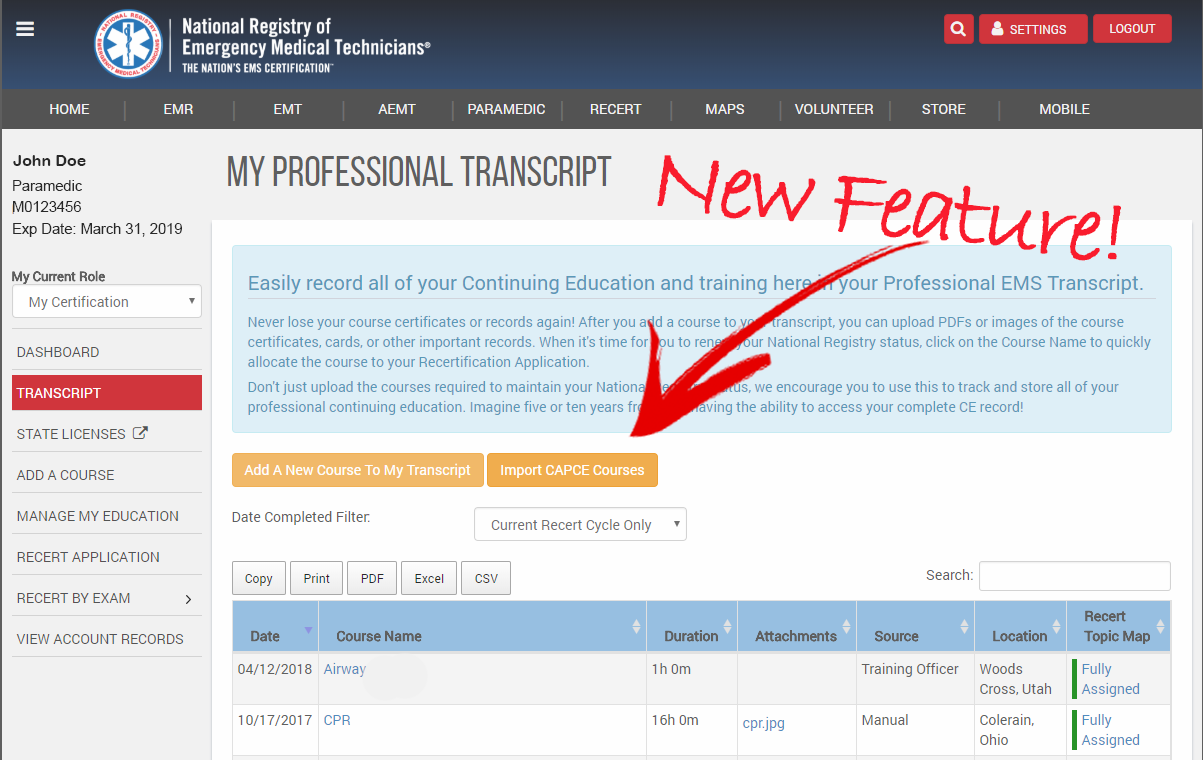
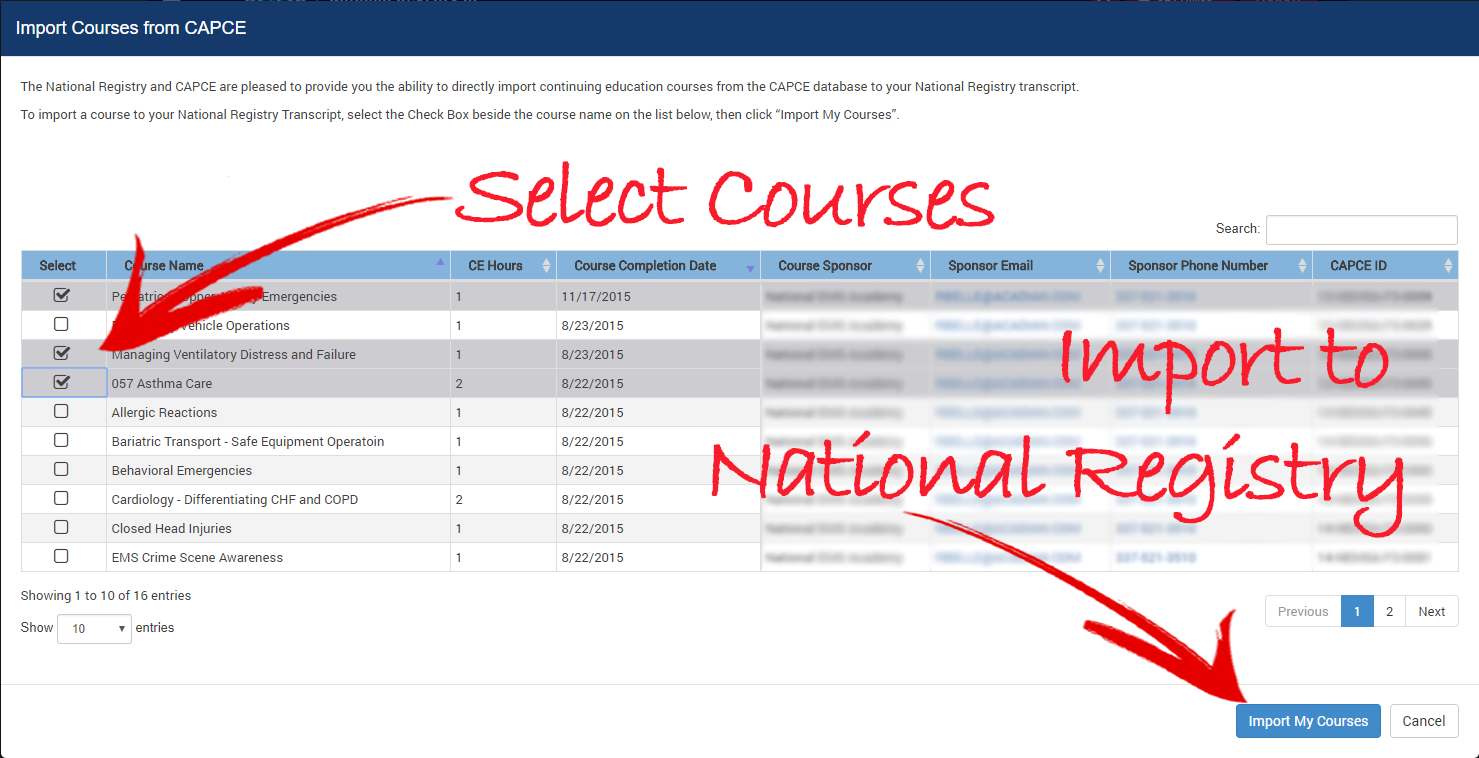
    The National Registry of EMTs (National Registry) and the Commission on Accreditation For Pre-Hospital Continuing Education (CAPCE) today announced a partnership that allows EMS personnel to import CAPCE approved continuing education course records directly into their National Registry account. The website integration not only saves time and eliminates duplicate data entry, but it also increases the accuracy of information submitted to the National Registry during the recertification process.

    “This system was designed and built by CAPCE and the National Registry with the goal of relieving the demands on our nation’s paramedics, AEMTs, EMTs, and emergency medical responders,” said Jay Scott, Executive Director of CAPCE. “We’re happy to provide validated continuing education data that will make the recertification process faster and easier.”

    The new website functionality allows Nationally Certified EMS personnel to import CAPCE accredited electronic transcripts – complete with the course name, completion date, and course sponsor – direct from the secure CAPCE database into their personal National Registry transcript.

    “We’re excited to provide a major time savings to our EMS personnel,” said Donnie Woodyard, Chief Operations Officer at the National Registry. “This also provides immediate validation to National Registry staff that the imported CAPCE courses are compliant during random and routine audits that we conduct.”

    CAPCE’s Accreditation Management System (AMS) currently holds around 10 million records and is growing at a rate 1.2 million records per year.
    CAPCE_New_Feature.png
    CAPCE_import.png

    About CAPCE
    CAPCE, by its charter, maintains the standards for the delivery of EMS continuing education. Those standards include requirements for active medical direction, valid post-tests, quality infrastructure, sound educational design including delivery methodology, marketing, fees, evaluation, student record keeping and data reporting. CAPCE accreditation exists so that EMS providers have access to high quality, standard-driven continuing education activities and are awarded credit for participating in such activities. CAPCE’s Board of Directors is comprised of liaisons from AHA, NAEMSP, NAEMSE, NAEMT, ACEP, ACOEP, NASEMSO, and NREMT.

    About the National Registry
    Since its founding in 1970, the National Registry of EMTs (National Registry) has offered the nation assurance that the men and women providing emergency treatment in the out-of-hospital setting are capable of providing the care that patients and their loved ones deserve. As the Nation’s EMS Certification organization, the National Registry provides psychometrically-valid proof of entry-level competence for Nationally Certified EMS personnel through rigorous cognitive and psychomotor examinations. National EMS Certification is offered at four levels and must be maintained biennially by demonstrating continued education and skills competence. To date, the National Registry has certified more than 1.8 million EMS professionals. Please visit National Registry to learn more.

    NEW WEB TOOL STREAMLINES RECERTIFICATION PROCESS FOR EMS PERSONNEL

    Media Contact:

    Shane Cartmill
    Communications & Marketing Manager
    scartmill@nremt.org